Preparation
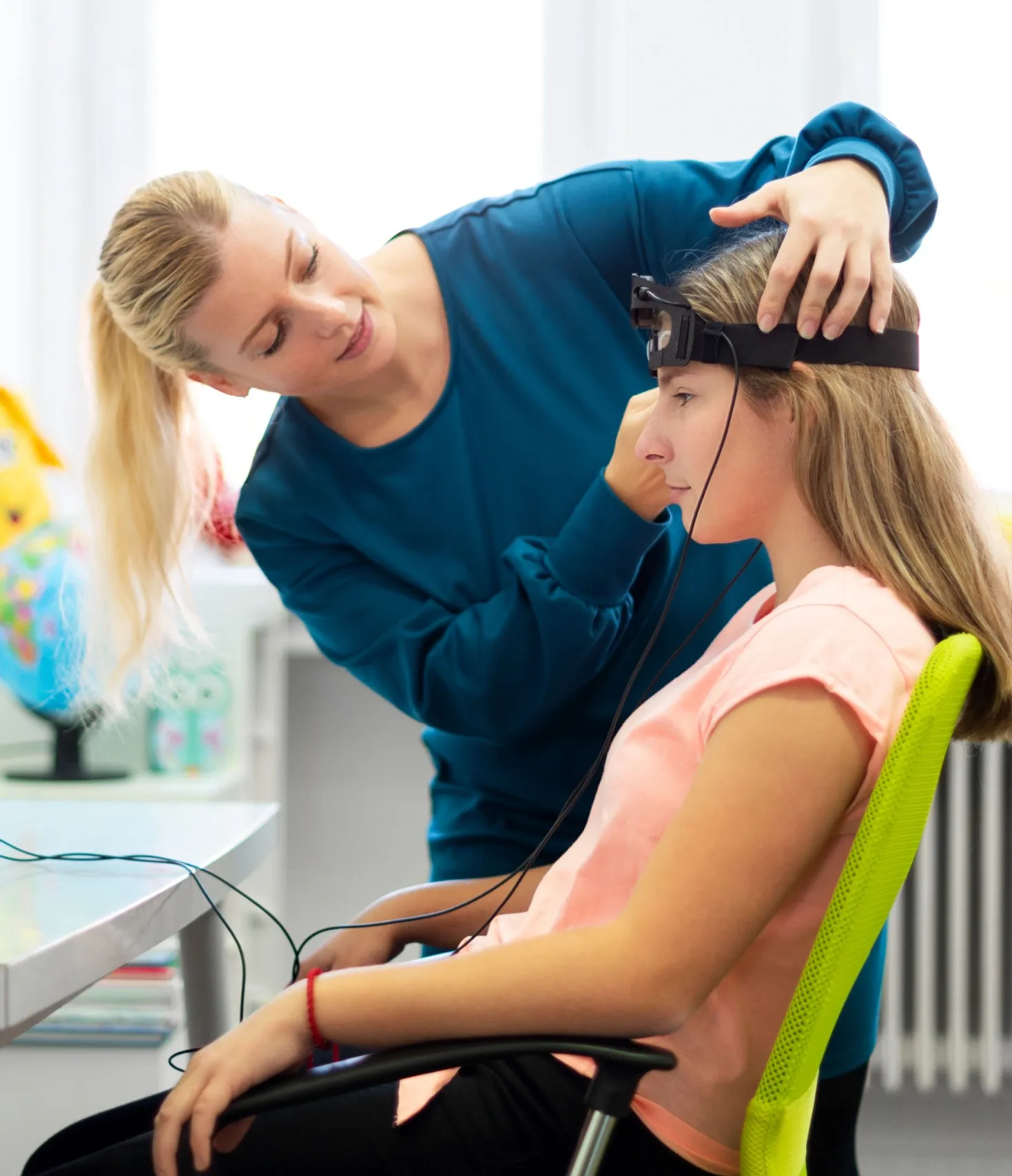
Your provider explains the process and places a comfortable sensor cap on your scalp using conductive gel.


Data-Driven Mental Health
The Missing Piece
Most mental health care relies on symptom-based evaluations and treatment adjustments over time. While this approach can be effective, it may not always provide insight into underlying brain activity patterns. Without objective data about your brain's electrical activity, treatment becomes guesswork. ADHD, depression, anxiety, and traumatic brain injury can all produce similar symptoms, but require different interventions.
qEEG brain mapping adds an objective layer of information by measuring electrical activity across the brain. By measuring brainwave activity across multiple scalp sites, qEEG identifies specific dysregulation patterns associated with your symptoms. This allows our clinical team to create truly personalized treatment plans based on your brain's unique signature, not just your symptom profile. Brain mapping transforms mental health care from educated guesswork into precision medicine, guiding targeted interventions like neurofeedback, TMS, or medication selection. Learn more from the International Society for Neurofeedback and Research (ISNR).

Quantitative Electroencephalography
Quantitative EEG (qEEG) brain mapping is a non-invasive diagnostic assessment that measures and analyzes electrical activity across your brain. Using EEG sensors positioned on the scalp, qEEG records your brainwave patterns while you're at rest with eyes open and closed. The resulting data is processed through sophisticated software that compares your brain's electrical signature to normative databases containing thousands of healthy individuals matched for age and gender.
Brain activity is measured across different frequency bands such as delta, theta, alpha, beta, and gamma. Variations in these patterns may be associated with attention, mood, and cognitive function. qEEG does not diagnose conditions on its own but provides supportive data that clinicians use alongside a full clinical evaluation. By identifying these specific patterns, our provider can determine which brain regions are over-functioning or under-functioning, providing a roadmap for targeted treatment.

Precision Mental Health

Provides measurable brain activity information
Supports more targeted treatment decisions
Can be repeated to monitor changes over time
Safe, painless assessment with no side effects
Decades of peer-reviewed validation in clinical populations
Helps guide decision-making alongside clinical evaluation
Assessment Options
| Assessment | What It Measures | Time | Objectivity | Treatment Guidance | Cost | Best For |
|---|---|---|---|---|---|---|
| qEEG Brain Mapping | Brainwave electrical activity | 60-90 min | Quantitative data | Guides neurofeedback/TMS | $$-$$$ | Treatment-resistant cases, TBI, precision care |
| Clinical Interview | Symptom self-report | 30-60 min | Subjective | General diagnostic category | $ | Initial assessment, broad screening |
| Brain SPECT Imaging | Blood flow & metabolism | 2-3 hours | Quantitative data | Identifies structural/functional issues | $$$-$$$$ | Suspected brain injury, dementia, complex cases |

Ideal Candidates
qEEG brain mapping may be helpful for individuals seeking additional insight into brain function as part of a comprehensive mental health evaluation.
During your initial consultation, your provider will review your medical history and current symptoms to determine if qEEG is the right diagnostic tool for your situation.
Your provider explains the process and places a comfortable sensor cap on your scalp using conductive gel.
You'll sit quietly for several minutes with eyes closed, then eyes open, while your brainwave activity is recorded.
Some protocols include cognitive tasks (reading, counting) to assess brain function under different conditions.
Your provider removes the equipment, you wash off any remaining gel, and the assessment session concludes within 30 minutes.
Your data is processed and compared to normative databases, generating a comprehensive report within 3-5 days.

What to Know
qEEG brain mapping is non-invasive and does not introduce any signals into the brain. It simply records existing electrical activity. The conductive gel used is designed to be easily washed out. Unlike MRI, there are no contraindications related to metal implants, pacemakers, or claustrophobia concerns. The procedure is generally well tolerated. If you have scalp conditions or specific medical concerns, these should be discussed with your provider prior to the assessment. The only discomfort is sitting relatively still for 20-30 minutes, which most patients find manageable.qEEG brain mapping at West Eastern Health is $375. This includes the 30-minute assessment session, normative database analysis, a comprehensive written brain report, and a 30-minute review consultation with your provider to discuss findings and personalized treatment recommendations.
Brain mapping is a self-pay service. We accept all major credit cards. Contact our office at (904) 593-8480 for pricing details.

Ponte Vedra Beach & Jacksonville
Specialized training in qEEG brain mapping and integrative neuroscience
Brain mapping directly informs neurofeedback and TMS treatment plans
Full qEEG assessment with normative database comparison
Detailed consultation explaining your results and treatment options
Discover complementary therapies designed to work alongside your treatment plan for optimal results.

Therapy, counseling, and holistic approaches for lasting emotional wellness

Non-opioid pain management through injections, PEMF, and neuromodulation
Your Questions Answered
Quantitative EEG brain mapping is a non-invasive assessment that records and analyzes electrical activity across your brain. The data is compared to normative databases to identify dysregulation patterns associated with mental health symptoms, guiding personalized treatment planning.
EEG sensors are placed on your scalp to record your brainwave activity while you sit quietly with eyes closed and open. The electrical signals are amplified, digitized, and analyzed using sophisticated software that compares your brain's patterns to age-matched normative data.
Brain mapping reveals the frequency, amplitude, and coherence of brainwaves across different regions. It identifies areas of over-activation or under-activation, asymmetry between hemispheres, and connectivity patterns. These findings correlate with specific symptoms like attention deficits, mood dysregulation, or anxiety.
Your brain map serves as a blueprint for neurofeedback training protocols, TMS target site selection, or medication considerations. By knowing exactly which brain regions and frequencies are dysregulated, our provider can design treatments that directly address your specific patterns rather than using generic protocols.
The assessment session is 30 minutes. Analysis takes a few business days, followed by a 30-minute review consultation with your provider to go over your report and discuss personalized treatment recommendations.
Most insurance plans do not cover qEEG as a standalone service. Contact our office at (904) 593-8480 to discuss pricing.
qEEG identifies patterns associated with conditions like ADHD, depression, and anxiety, but is not used alone for diagnosis. It provides objective data that complements clinical assessment, helping to clarify complex presentations and guide treatment selection.
Most patients undergo initial brain mapping before starting neurofeedback or TMS, then follow-up mapping after 20-40 sessions to track progress. Some clinicians recommend annual mapping for ongoing brain health monitoring, especially after traumatic brain injury.